The LATEST
“My own twisted look at my visible part of the
world!”
Well, after a couple of cups of Community coffee
this morning, the creative juices have started flowing for some
incomprehensible reason. At least I
hope it is creative juices and not something else, so here goes.
I was awakened at 0600 this morning to the sound of
thunder. I got out of bed like a kid on
Christmas morning and ran to see if it was raining, and sure enough, it
was. It rained for about fifteen minutes
and then QUIT! So, now my grass will
still be tan, instead of green, and the humidity will be on the level of a small,
be-jungled Central American country. Why
can’t the grass just suck the moisture out of the air and solve two problems?
The word ‘politics’
has been described as being derived from the Greek word ’poli,’ which means ‘many,’
and ‘ticks,’ which are described as ‘blood-sucking vermin.’ I recently sat down in my chair after an
exhausting day running a weed-eater, and I discovered a tick crawling across my
leg. While they were somewhat common in
Alabama, they are somewhat uncommon here.
This is the first one I have seen in ten years. They are very thick in Alabama due to the contiguity
of all of the pine forests that are native to that region. About twenty miles east of where we lived in
Golden Springs there was purportedly a nudist camp. I am told most images of nudist, or ‘naturalists,’ as they are sometimes
called, are beautiful people in sandals, sunglasses, hats and little else
playing volleyball. I cannot for the
life of me, however, remove the image from my head of a bunch of nudists
squatting around picking the ticks off of each other like monkeys pick off the
lice!
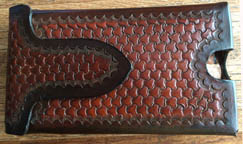
I recently completed a phone holster for a friend
and was very pleased with the outcome. I
would like to make more, but there exist so many different sizes and shapes of
the blasted phones that I cannot possibly afford the clicker dies, that it
would take to make them. Clicker dies
are something like heavy-duty cookie cutters for making repetitive cuts in leather,
paper, cardstock, gasket material, etc. A
proper clicker die, which cuts out the shape and punches the holes in the
leather, costs about $450 each, and I would need a dozen of them. I would have to make a lot of phone holsters
to pay for that. Still in all, I think
it turned out well.
I have been fishing several times this year and
have caught nothing! It seems
that it is either too hot, too cold, raining, windy, or whatever excuse the
fish are using to not bite. The closest
I came to catching anything was a three-inch shad attacking a three-inch shad
plastic lure. I got him out of the
water, but he escaped! I need a boat,
but Darling Companion takes a dim view of the idea. We’ll see!
I have discovered that with the Internet I have
become somewhat popular overseas. I am
currently corresponding with an individual from Germany who is fabricating WWI
U.S. Artillery harness for his own use!
He plans on making and pulling a fake ‘French 75. https://en.wikipedia.org/wiki/Canon_de_75_mod%C3%A8le_1897
. Fortunately, over the years I have
collected a lot of this data from generous individuals at little or no costs,
so I am passing it on at that same rate.
I have been also assisting an individual from Eastern France in
translating his work on artillery into English.
Between his knowledge of English, my knowledge of French, and Google
Translate, we are getting the job done. The
latest one we have done is the ‘15cm s.FH
13/1 (Sf) auf Geschützwagen Lorraine Schlepper (f),’ which translates into
English as the ‘150mm Heavy Field
Howitzer Model 13/1 (Self-Propelled Carriage) on Gun Vehicle the Lorraine
Carrier (French).’ Leave it to the
Germans to not make it easy. Unfortunately,
my German is not as good as my French. This
is a 15cm Howitzer, Model of 1913, mounted on a captured French Lorraine cargo carrier
and used by the Germans in WWII. These
will be released on some format, possibly CDs, in the foreseeable future.
Do you know what a ‘bezel’ is? For the purposes
of this discussion it is the plastic thing that holds the bulb and the lens of
the right side-marker light on a 2004 Toyota Tacoma PreRunner. Last Thursday I had to sit and wait on
contractors fixing the threshold on our front door, so I had Darling Companion
pick up a couple of the very small lightbulbs for the side-markers on my
truck. I got on YouTube and found a
video on how to change the pencil-sized bulbs.
Open the hood, take out one screw, pull the bezel forward, remove the
burned out bulb and replace it with a new one, rinse and repeat. What could be simpler? I decided to change both bulbs since they were
both fourteen years old. Well, the bezels
on the YouTube video apparently had been taken out regularly and weren’t on a
truck that had not had the bulbs changed in fourteen years and 198,000
miles. The left bezel was changed with
little or no trouble or effort, but typically with my record of success in all
things, the right one decided to be difficult.
First of all, there is a little tab for that the screw secures to the
truck. This little tab fits over a small
ridge and has to be lifted up a sixteenth of an inch to remove it. On the right one I did that and broke the
little tab with practically no effort.
Okay, this is bad, but not a catastrophic failure as there are two more
spring-loaded locking tabs that hold the bezel in, but in the immortal words of
Inspector Clouseau, “Not anymore!” As I pulled forward as instructed in the
video I broke one of the other tabs! Well,
after changing the miniscule light source, I replaced the bezel, hoping against
hope that it would hold until I found one for sale or in a junk yard. Friday, I went to Fort Sill to give a 3-1/2
hour class to Basic Trainees. On the way
home in heavy traffic I feel something hit the right rear wheel on my truck
followed by the sound of crushing plastic.
Well, there goes the bezel, sometimes that is how the cookie, or in this
case the bezel, crumbles. Imagine my
surprise when I got home and the bezel was still attached swinging wildly by
its wires! I re-attached it with that
red-neck fix-all . .
. duct tape!
Now the question remains, “What did
I hit?”
I have been teaching classes for Advanced
Individual Training (AIT) at Fort Sill for several years. They consist of the 13B Military Occupational
Specialty (MOS) the ones that actually load and fire the guns. These are the strong ones. The 13J MOS, the
guys, and now girls, who do all the calculations to fire the howitzers. They must calculate deflection (direction),
quadrant (angle), range, determine which round to use, which fuze and fuze
setting to use, and which powder charge, of which there are usually seven. In this they must also calculate the powder
temperature, air temperature, humidity, any winds in the upper atmosphere and
even the Coriolis Effect, which is the distance the earth rotates while the
projectiles are in the air. Needless to
say, these are the smart ones. The 13F
MOS are the brave ones who go out with the Infantry or Armor units and actually
see the target and call in fire and adjust it.
I like all of these and the kids really seem to respond to the classes. I am not so enthusiastic about the 13M MOS,
the rocket jockeys and the 13R MOS who handle the radars. I don’t know a lot about their topic and they
tend to look down their noses at the rest.
I am inordinately fond of and have read extensively
on Neanderthals. They are our closest
human relatives and they disappeared after populating North Africa, the Middle
East, Europe and East Asia about 250,000 years.
They made their departure shortly after our ancestors arrived 25,000
years ago, so one has to wonder if there was any connection. Most people of European, Middle Eastern,
North African and Asian decent have from 1% to 4% Neanderthal ancestry. Neanderthals were short, powerfully built,
had no chins and their foreheads sloped back radically. Their faces sloped backwards with the nose in
front and the forehead and chin sloping backwards. They lived in the coldest, most brutal
climate nature has ever inflicted on humankind and they thrived there for
250,000 years. They have been called
knuckle-draggers, caveman, slope-heads, ape-man and any number of other derisive
and scornful soubriquets.
One day we had a class of about sixty 13B’s and
divided them up between three instructors.
I gathered my group and moved them to the starting point, I noticed one
guy in the front with no chin, sloping forehead, short and powerfully built
physique and large brow ridges, all the physical characteristics of a classic
Neanderthal. I thought to myself, “Self, that’s not right! I shouldn’t think that about someone I have never
even met.” Well, the class starts
and Mr. Neanderthal is bright and intelligent, very interested, asked lots of questions,
made some interesting observations and even laughed at my futile attempts of
humor! So, my opinion of him, even if he
did look a lot like a caveman, bolstered my positive opinion of
Neanderthals. When the class was over
and the troops had departed, the instructors were gathered in preparation for
their own departure. One of them asked, “Who had the Neanderthal?” Okay!
I wasn’t the only one that noticed that.
Still, Mr. Neanderthal made a very good impression on me and appeared to
have the makings of a good soldier.
Looks can be deceiving.
We have also started to do programs for Basic
Trainees. Since these can become almost
any MOS, there seems to be a lot of medics, MPs and dog handlers, spooks
(Military Intelligence), in addition to a few artillerymen. Since they can be any MOS they get a general
history of the U.S. Army and not the Artillery-specific one the Artillery trainees
get. We have several stations starting
at the Revolutionary War, Civil War, Spanish-American War, World War I and
World War II. There are also two
scavenger hunts where teams of trainees roam around specific galleries of the
museum looking for facts and documenting them on the sheets provided. There are seven groups in all and they rotate
on about twenty-five minute intervals. These classes are given using some real
artifacts from the various wars, and reproductions of the more delicate and
difficult to obtain items. Instructors
are attired in reproduction period uniforms.
The Rev War and Civil War guys even take them outside and fire blanks
from reproduction flintlock and percussion muskets.
My station is WWI and I portray what is apparently the
oldest private in the U.S. Army in that conflict!

I wear a wool uniform that feels like two
wool blankets that are lined with 60-grit sandpaper. The standing collar is a real pleasure, as it
abrades the neck, but the wrap leggings, or puttees are even more fun. The puttees are about fifteen feet long and
four inches wide and are made of wool.
It takes several minutes to don them by laboriously wrapping them around
each leg, and if that is not done correctly, they come loose and become a trip
hazard. If done correctly they are
miserably hot. Fortunately, my station
has an air conditioner register in the floor or I couldn’t make it through the
entire three and a half hours. The WWI
Brody helmet looks cool, but is equally uncomfortable as it wobbles around
almost uncontrollably on one’s head. I
like handing the students a .30 Cal Rifle, Model of 1903 Springfield with its
attached M1905 bayonet. It is about
twice as heavy as what they are accustomed to.
Like the Artillery trainees, the kids seem to like the program, if
nothing else for the fact that they are inside under chilled air, not crawling
through the dirt and no one is yelling at them
. . .
well, I yell at them when they don’t move fast enough or go to
sleep. I find, however, that the modern
drill sergeant does not yell nearly as much as the 1960’s version did. Ours could all pass for Gunnery Sergeant R.
Lee Ermey.
One of Darling Companion’s friends once asked me if
I wouldn’t want a kitten in the house, to which I responded “I don’t like kids in the house!” I like dogs, because the love and respect
you. I dislike cats mostly because they only
think of you as ‘staff!’ Neither, however, contributes to the
cleanliness of the domicile, in fact, both tend to contribute to the
disorder. Since my Darling Companion
suffers from severe back problems and Kevin, that little heathen, got married
and moved out, I am left to perform all of the housekeeping functions
myself. I have a year-long “First of the Month” list so that I don’t
forget anything, like winding the wall clock, changing the furnace filters, and
such! I faithfully follow it so I don’t
forget anything.
Well, for Father’s Day Kevin and DC purchased for
me a ‘Roomba,” sort of a
self-propelled, self-parking vacuum cleaner.
It does a remarkably good job, especially under the beds, which I have
not cleaned under for a couple of years, and are the domicile of dust bunnies
the size of tom cats! It requires some
preparation before it can be set free to do its duty, but that is minimal. Sometimes I have to set up barriers of chairs
laid on their sides to prevent it from attempting to clean too big an
area. I do this on Sunday morning
because it makes an ungodly racket around the dining room table by smacking
into the chairs and clacking across the ceramic tiles. Since it isn’t Catholic, I am not concerned
with it working on Sunday. DC submits
that it is like leaving a toddler alone for several unsupervised hours. Since it is such a hard-working addition to
the family, I have decided that it is officially my “dog.” I named it “Fideaux.”
This month’s song is entitled, “The Balls of O’Leary,” and if you have a problem with blue humor,
you may not want to listen. However, knowing my readers mentality, I
cannot help but think all of you will open it.
I enclose two versions for the more discriminating:
Well, that about wraps it up. I leave you with this thought, “The voices in my head may not be real, but
they have some interesting ideas!”
Until next time, I am the ex-patriot Creole,
Lynden T. Couvillion
Scribe