Saturday, June 16, 2018

Pack School


Pack School
Fort Sill, Oklahoma, circa 1935

The following are electrostatic copies of unknown origin of photographs of the Pack School at Fort Sill, OK, in the 1930’s.


The road to the right in the photograph is Geronimo Road, which runs generally north-south.  It intersects with McComb Road at the bottom right.  The buildings in the lower right, one with a dark roof and one with a light roof and six windows are the Pack School buildings.  The building with the dark roof has since been demolished. 

The long narrow buildings in the center, they are actually of blue-gray stone with white composition shingle roofs, are also part of the Pack School. The building in the upper left with the evenly spaced chimneys and sets of three windows is the Farrier’s School.  The next series of six buildings below the Farrier School are the stables for the Pack School. 

The small building at left, with the truck parked next to it, is the Pack Artillery School.  The ‘Artillery’ part of Pack Artillery differs little from regular Field Artillery.  Its transportation differs radically.

In the extreme upper right corner of this image are the original Cavalry Barracks and behind them the Laundresses Quarters and the Sinks (toilets.)  The circular feature in the upper left, beneath the hand-written word ‘Moore,’ is the remains of one of the original fortifications, a five-sided trench system that had a 12-PDR Mountain Howitzer in the center.


One 75mm Pack Howitzer, M1, packed on six mules with the howitzer crew following.  This is just the animals that carried the howitzer.  There were sixteen mules to a section; the Chief of Section rode the spare mule.  Each section, Headquarters, Commo, Ammo, Anti-Aircraft, Mess Section, etc., had its own set of horses and mules, about 200 to a firing battery.  Service Battery, which had the Ammunition Section, had about 400 horses and mules.  This image was taken between the southernmost stable and the Pack Artillery School.


I am not sure which building this is, but there is a forge and anvil to the left, and a dismantled escort wagon in the background.  Note the stove, a ‘Cannon Heater,’ in the background.


Saddler’s School.  I am not sure which building this is, but it may be the one in the lower right foreground.  I really want that sewing machine.


This last image is of the Farrier’s School.  It is the long white building in the upper left in the first photograph with the evenly spaced chimneys and sets of three windows.
Most of these buildings are still in use as offices and the paddocks are now a parking lot. 

Note the stove, the ubiquitous ‘Cannon Heater,’ in the foreground.  These were still in use in range shacks when I was in service in the 1970’s.  They may still be.

Wednesday, September 20, 2017

Interesting Saddle

I am looking for help identifying this saddle.  It resembles a McClellan saddle, the pitch on the pommel and cantle are the same as the M1904, but the shape of the pommel and the horn are radically different.

Near side:


Off Side:  


Pommel:

Note pommel and horn details compared to
the M1913 McClellan in the background.

Cantle:


Cantle Seam Detail:

The lace if fibrous and looks more like sinew than rawhide.
Detail of off side bar at cantle:

Note iron staples, iron ring and method of attachment.


Monday, June 15, 2015

Saddles from Mordecai Drawings

Saddle and bridle from Mordecai Field Artillery drawings.  I am not sure if this is from the 1841 edition or the 1849 edition, or, for that matter, any other editions.


Wednesday, March 18, 2015

U.S Army Packers Can Pack Anything


Back in 1970 I witnessed a wedding where the bride and groom were carried from the chapel to the reception on a 155mm Howitzer, M114, commonly called the “155 Pig.”  I thought that was strange, but apparently, I wasn't done.


I received these photographs in an inquiry and thought them interesting.  I have no idea where this is or who this is.  My thanks to the inquirer for allowing me to post them.


The bride and groom appear to have complete confidence in the mules and drivers.


Oddly for this time, the bandsman with the Sousaphone is Black, while the rest of the band is White.  The elderly gentleman in the right foreground appears to be carrying some sort of civilian small arm, the purpose of which cannot accurately be determined.


Good photograph of Escort Wagons in column. 

Saturday, February 28, 2015

Artillery Whip

I have been asked the function of the hook on the American Civil War artillery whip, or 'stock,' and where it was stored on the saddle or harness when not in use.

I would welcome any comments.


Tuesday, April 8, 2014

POLO, Anyone?

On an Army post with several thousand horses and riders, it is natural for the sport of polo to be played.  Fort Sill teams won several international competitions over the years and brought home large bronze trophies to prove it.  The mechanization of the Field Artillery eventually eliminated the sport from play.

These are photographs I took today at the Polo Club at Fort Sill Polo Club.  Quality is not too good, but you will get the idea.  I did not get a photograph of the exterior of the building, but will add it when I get one.


Polo players at Fort Sill, circa 1890.


Enlargement of photograph above, note that the first and third individuals from the left are playing on western saddles.


Polo match in front of the Post Trader’s home.


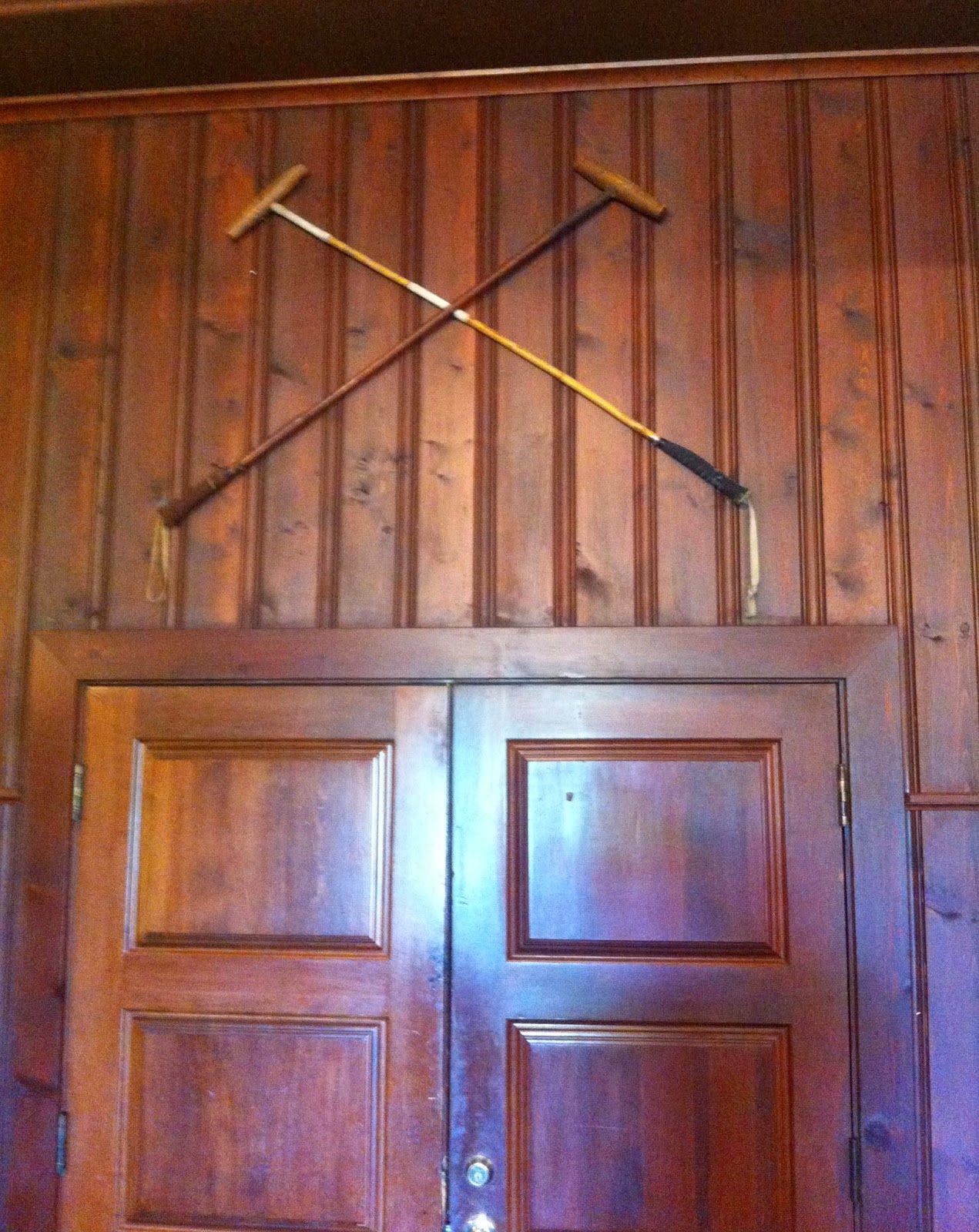
Polo mallets on display at the Polo Club.


Odd light fixture with at thunderbird at the top and a horseshoe suspended.  There appear to be very old.  The building was built in the 1920’s, or there about, and I believe that the fixtures are contemporary to the building’s construction.


Mantle with trophies.


Fireplace and mantle with trophies.  Note the saddle to the right of the fireplace.


Saddle to the right of the fireplace.


Two of many photographs exhibited in the Polo Club.

New York Times Article: Fort Sill Wins Dull Polo Game


WASHINGTON, July 19 (1913). – The Fifth Artillery team from Fort Sill, Okla., to-day won a slow and rather uninteresting polo match from a Washington team of army officers by 4 ¼ to ¼ goals.  It was a consolation game following the elimination trials for the Narragansett Pier matches at which the mounted service school team from Fort Riley, Kan., won the right to represent the army.  Fort Sill displayed the better team work to-day, but the losers showed frequent brilliant individual plays.

Friday, February 19, 2010

Late 19th Century US Army Wheeled Vehicles

These illustrations are from a book with the daunting title of:

SPECIFICATIONS

FOR

MEANS OF TRANSPORTATION,

PAULINS, STOVES AND RANGES,

AND

LANPS AND FIXTURES

FOR

USE IN THE UNITED STATES ARMY


Government Printing Office, Washington, D.C., 1882

Six-Mule Army Wagon:
Pulled by six mules with the driver on the near wheeler controlling the team with voice commands and a jerk line. The wagon weighed 1,950 pounds and could carry about two tons.
Some forms of this wagon were used until the 1930's by Engineer pontoon bridge companies to carry the pontoons, trusses and chess.


Two-Horse, or Four-Horse or Four-Mule Wagon:
Similar to the later Escort Wagon, this vehicle carried about a ton. The driver controlled his undetermined number of animals from the driver's seat with reins. Wagon weight was 1,555 pounds and it carried about one ton.


Sectionalized view of the Two-Horse, or Four-Horse or Four-Mule Wagon.
Note how the internal seats are sprung.


Dougherty Spring Wagon:
A form of stage coach utilized by the US Army, pulled by two to four animals.

Ambulance
Sectionalized view of the Ambulance.